Late AuDHD Diagnosis
I lived my life as a quirky, “gifted” neurotypical. I was in the Talented and Gifted (TAG) program in early elementary school, which I don’t believe even exists anymore. For the unfamiliar, schools would identify the “bored” students and routinely administered IQ tests and other assessments to separate the “problem” children from the “gifted” children. My “too talkative” and “won’t sit still” became a positive that teachers could handle because I went to a special class for a few hours every day that was designed to engage and challenge me. Also, I was a girl and no one knew quite what to do with girls at the time. My brother was not so lucky. He also had dyslexia that no one recognized or even knew to look for at that time and was labeled a “problem” instead.
I stayed bored for the most part, but sometimes the special class would spark an interest or present an interesting challenge. When it didn’t, I had difficulty engaging. I understood on some level that I needed to reign in my restlessness and boredom. I began wiggling my toes because no one would notice inside my shoes instead of shaking my leg that drove everyone crazy. I also have a very particular thing I do with my hands that I didn’t even notice until my husband commented on it, so I still think that one is safe, but I do wonder how many have noticed and not commented. I understood and accepted very early on that few want to listen to my passion of the day. That was my introduction to masking and mirroring. I was identified as “gifted” but also lonely, disconnected, and exceptionally bored. I was an observer, a researcher, detached in so many ways, desperate to fit in but never successful. In early childhood, I once said, “I’m bored.” The response I received was, “You must be boring,” so I figured out how to not show my boredom so often and dived even deeper into my passion of the moment.
I was neurotypical. I was “normal,” so what was so wrong with me that I have so much trouble connecting and just existing. Forget that my socks have to be a certain way and that I have learned to be pretty good at reading lips because I hate noise and avoid loud obnoxiousness at all costs. Why is everything so exhausting and everything feel so performative? I want to be myself, but what even is myself? I decided (based on the best information I had available at the time) that I was an introvert, a special kind of introvert maybe. I wanted and craved social interaction but needed recharging time (sometimes an inordinate amount of time that became noticeable over time). I love social interaction, but it is draining. My behavior isn’t exactly performative (masking/ mirroring), but it is horribly draining at times.
I had the privilege of having a fantastic colleague who asked me a simple question, “Do you have ADHD?” I responded, “No, I don’t,” but she was an ADHD specialist and the question lingered in my mind. She knew and recognized the presence of the undiagnosed. I resisted , but I also could not let it go, as is the neurodivergent way. The more I read and understood, the more I resisted.
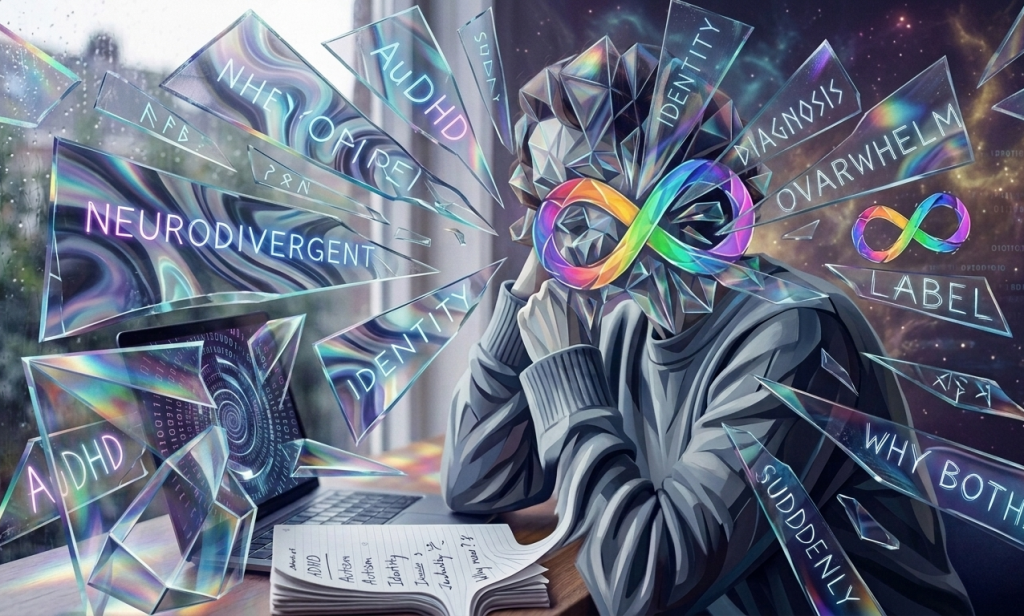
I am neurotypical. With every article I read that used the word neurodivergent, the angrier I felt. Angry isn’t the right word; I just felt more and more frustrated and aggravated until I wanted to scream every time an article used the word. Why does this word even exit? And why does every researcher use it so flippantly? Why did I use it so flippantly in the past?
When a word is applied very directly to you, the meaning of that word changes. Words are important, and they matter, and it is not just because that is my particular AuDHD flavor (maybe it is just me, but probably not). Talking about, thinking about, and experiencing a thing are not the same.
A diagnoses changes you, sometimes for the better and sometimes for the worse. You might think, “Finally, all this I’ve been experiencing makes sense” or you might think, “No, I don’t like that; that’s not me.” I’ve experienced both. But the thing is, you are you and you are the only you that has ever existed or will ever exist. Be the best you that you can be regardless of any diagnosis or other words that are holding you back.
Nothing substantial has changed. I am still the same person I have always been even though many of my “quirks” are now recognized as “symptoms.” I am still just as normal as I have always been, but now I understand that task paralysis and perfectionism and all the rest can be managed, overcome, accepted, and forgiven instead of just being something with which to cope and hide.